



Quick Answer
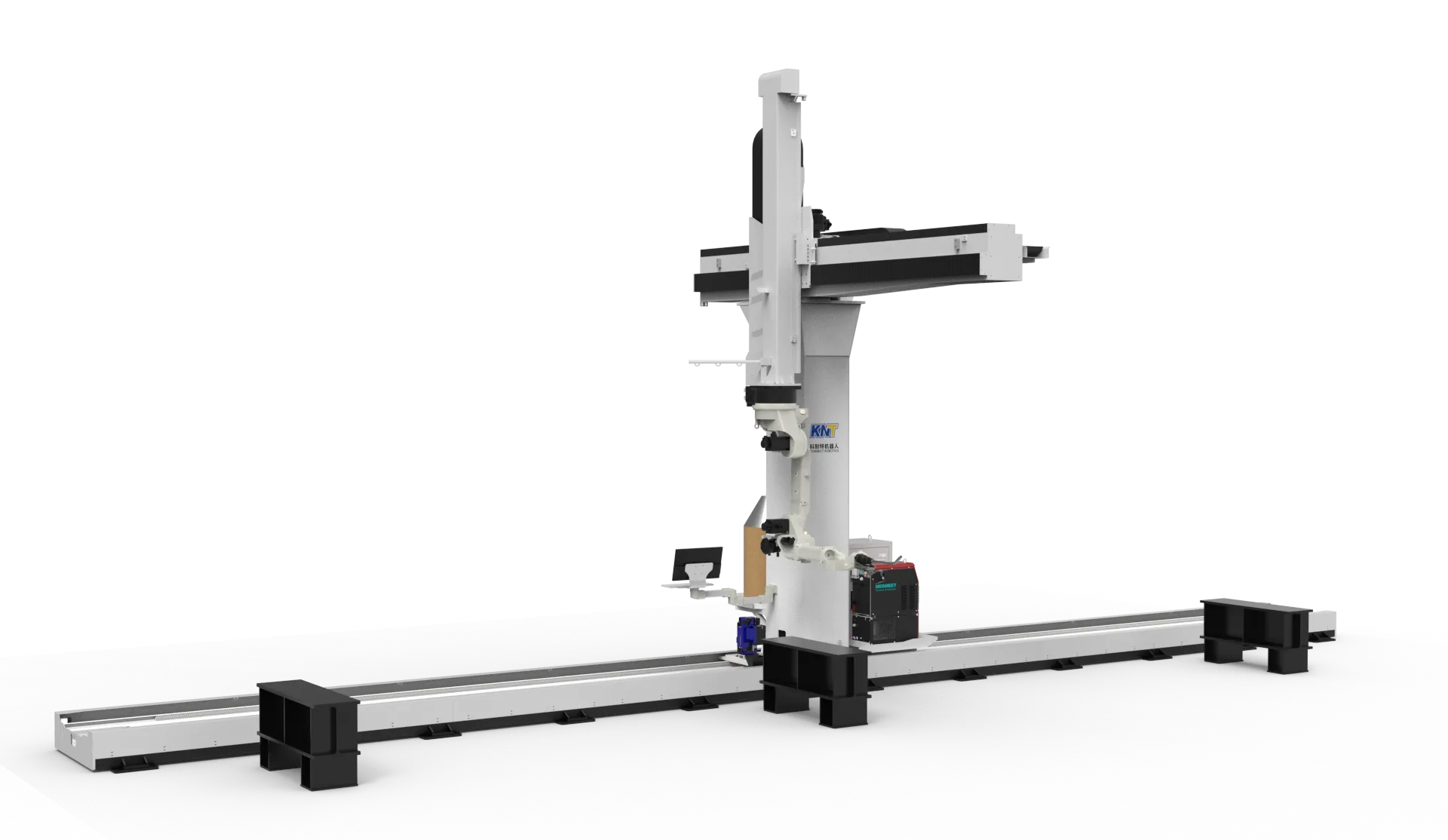
A robotics welding workstation is a pre-integrated welding cell that combines an industrial robotic arm, welding power source, torch, travel axis or positioner, safety layout, and control software to weld steel components consistently and automatically. For steel structure, power tower, shipbuilding, rail transit, and special vehicle fabrication, manufacturers use cantilever, ground-rail, and positioner-type workstations to reduce manual labor, improve weld quality, and raise output. KNT (Jiangsu Connect Intelligent Welding Robotics Co., Ltd.) supplies customizable robotic welding workstations built around a no-programming, no-teaching workflow, with a mature welding process database and one-key start operation.
What Is a Robotic Welding Workstation?
A robotic welding workstation is a complete welding system rather than a single robot arm. Depending on the configuration, it typically includes:
- An industrial welding robot arm with a dedicated welding controller
- A welding power source and gas-shielded welding torch
- A travel structure: cantilever/gantry frame, ground rail (track), or welding positioner
- Fixtures and supports for the workpiece
- Safety layout, cable management, and optional cleaning or dust-extraction units
- Process software, weld parameter libraries, and operator controls
Instead of a welder manually guiding the torch along every seam, the workstation repeats the programmed or AI-assisted path on each part. This keeps weld size, penetration, and appearance consistent across large batches of steel components.
Main Types of Robotic Welding Workstations
KNT designs three common workstation families for heavy fabrication. Choosing the right one depends on workpiece length, weight, seam layout, and available floor space.
Cantilever (Gantry) Welding Workstation
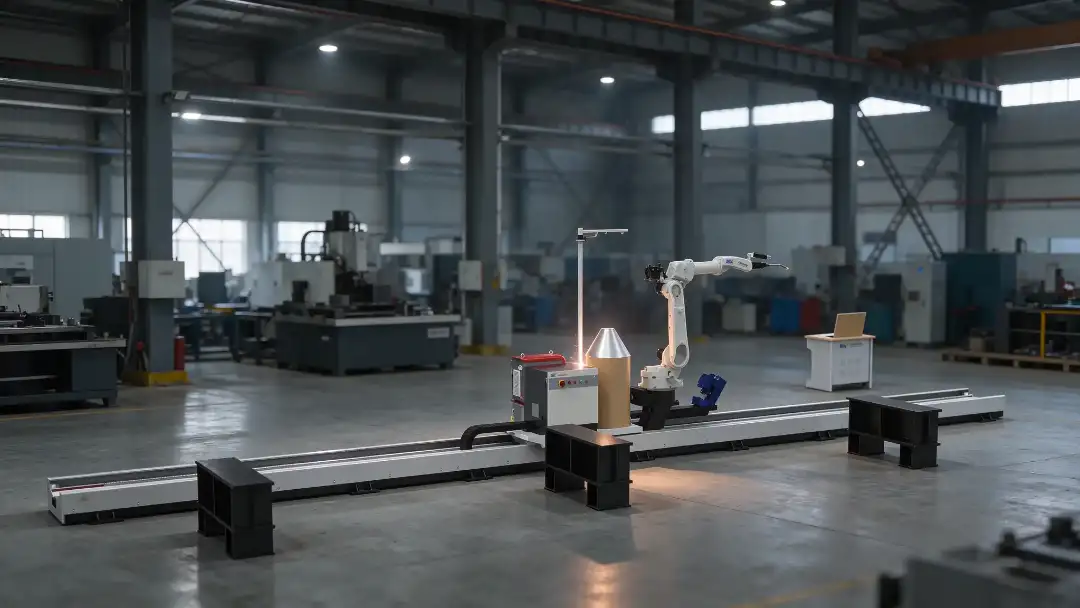
The cantilever series mounts the robot on an overhead frame so it can reach across long workpieces. It suits large steel beams, trusses, columns, and structural members that need welding from multiple sides.
- KSXB0018 – 9-axis cantilever welding workstation:
three-axis mobility (X, Y, Z), working range W3500 × L14000 × H2200, lead time 4–8 weeks. - KSXB0014 – 7-axis cantilever welding workstation:
X-axis and Y-axis mobility, working range W1500 × L12000 × H2000, lead time 4–8 weeks.
Ground-Rail (Track) Welding Workstation
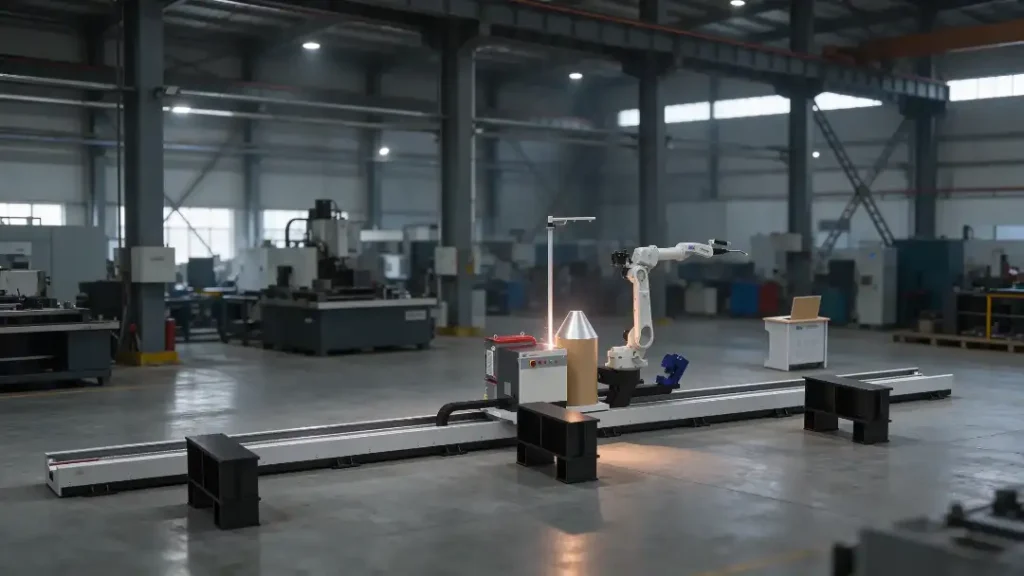
The track series uses a ground rail to extend the robot’s working length along long components. It is often chosen when parts are too long for a fixed gantry and the workstation needs to travel along the seam.
- KSDG0012 – track series welding workstation: rail-mounted robotic welding station, working range W1500 × L12000 × H1300, lead time 4–6 weeks.
Welding Positioner Workstation
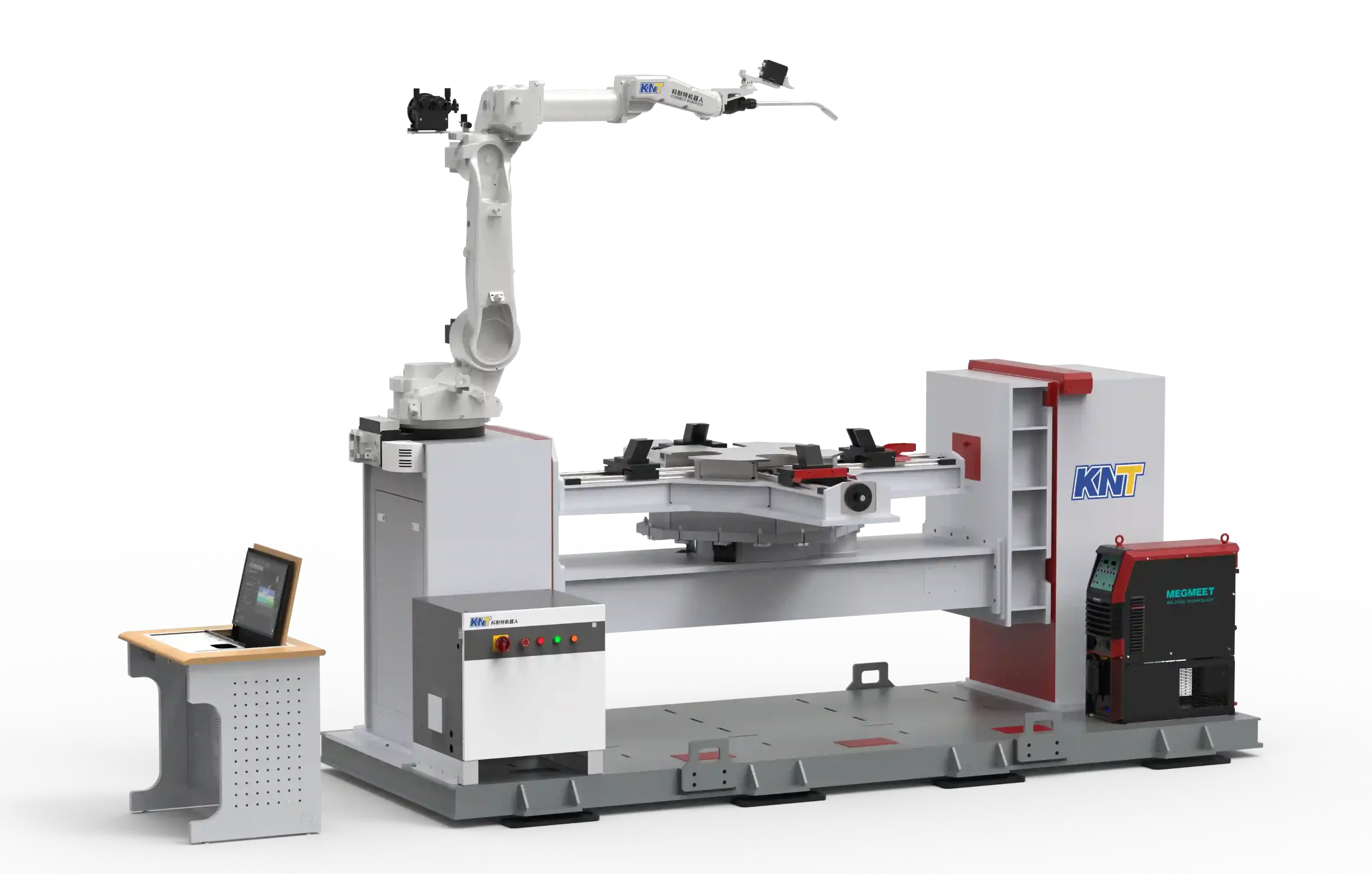
Positioner workstations hold and rotate the workpiece so the torch can reach the correct welding angle. KNT offers the BW series in both H-type and L-type positioner configurations, customized to the part shape and production rhythm.
Product Comparison
表格
| Model | Type | Configuration | Working Range | Lead Time |
|---|---|---|---|---|
| KSXB0018 | Cantilever series | 9-axis, X/Y/Z mobility | W3500 × L14000 × H2200 | 4–8 weeks |
| KSXB0014 | Cantilever series | 7-axis, X/Y mobility | W1500 × L12000 × H2000 | 4–8 weeks |
| KSDG0012 | Ground-rail / track series | Rail-mounted movement | W1500 × L12000 × H1300 | 4–6 weeks |
| BW series | Positioner workstation | H-type / L-type, customized | Customized to application | On request |
Key Benefits for Steel Structure Manufacturers
- Fewer operators per line: one operator can supervise multiple KNT machines, replacing repetitive manual welding stations with intelligent welding cells.
- Consistent weld quality: the workstation follows a stable path and repeatable parameters, reducing uneven beads, spatter, and rework.
- Higher output: automated cycling reduces idle time and supports longer production runs of structural steel parts.
- Safer working conditions: operators stay away from arc flash, fume, and heavy workpiece handling.
- Process support built in: KNT provides a large, mature welding process database and AI-assisted one-key start operation.
- Lower entry barrier for new operators: the no-programming, no-teaching workflow is designed so operators do not need advanced robot programming skills.
How to Choose the Right Workstation
When selecting a robotic welding workstation, evaluate:
- Workpiece size and length: long beams or trusses usually point to a cantilever or ground-rail system.
- Workpiece weight and rotation needs: heavy parts that must be tilted or turned need a positioner workstation.
- Weld seam type: fillet welds, groove welds, and multi-side joints may require additional axes or fixtures.
- Floor space and layout: confirm the footprint, rail length, and loading direction on your shop floor.
- Future scalability: leave room for additional stations, cleaning units, or later fixture changes.
- Customization needs: arm brand, welder model, track length, exterior color, and logo can usually be specified.
Why Choose KNT / CONNECT
Jiangsu Connect Intelligent Welding Robotics Co., Ltd. (KNT) focuses on free-programming and free-teaching welding robots for the steel structure industry. Its solutions are applied across steel structure, power tower, shipbuilding, rail transit, and special vehicle fabrication.
KNT also provides:
- Product customization: logo rendering, RAL color matching, and machine model customization, including arm brand, welder, cleaning station, and track selection.
- After-sales support: dedicated VIP service with a 24-hour quick response across time zones.
- Installation and on-site training: technical specialists install the equipment and train your operators on-site, with remote follow-up until the team is confident running the line.
Frequently Asked Questions
What is a robotic welding workstation used for?
It is an automated welding cell that welds steel and metal components using a robot arm, torch, travel axis or positioner, and process software. It is widely used in steel structures, power towers, shipbuilding, rail transit, and special vehicles.
Which robotic welding workstation suits steel structure fabrication?
Long beams and trusses usually suit a cantilever (gantry) or ground-rail workstation; parts that need rotating are better matched with an H-type or L-type positioner workstation. KNT can recommend a configuration based on your workpiece dimensions and production volume.
How many operators are needed for one robotic welding cell?
Most KNT workstations are designed so one operator can oversee multiple machines. The operator monitors quality, loads and unloads parts, and handles exceptions rather than welding manually.
Can the workstation be customized to our products and brand?
Yes. KNT supports custom arm and welder selection, track and fixture design, RAL color matching, and your logo applied to the machine exterior.
What lead time can I expect?
Cantilever series workstations typically take 4–8 weeks, while the ground-rail series usually takes 4–6 weeks, depending on the final configuration.
Does KNT support overseas installation and training?
Yes. KNT provides on-site installation, operator training, and remote after-sales support, with a 24-hour response commitment.
Ready to Configure Your Welding Workstation?
Send your workpiece drawings, dimensions, material, and required weld type to KNT. The engineering team will propose a cantilever, ground-rail, or positioner-based robotic welding workstation tailored to your production line.