




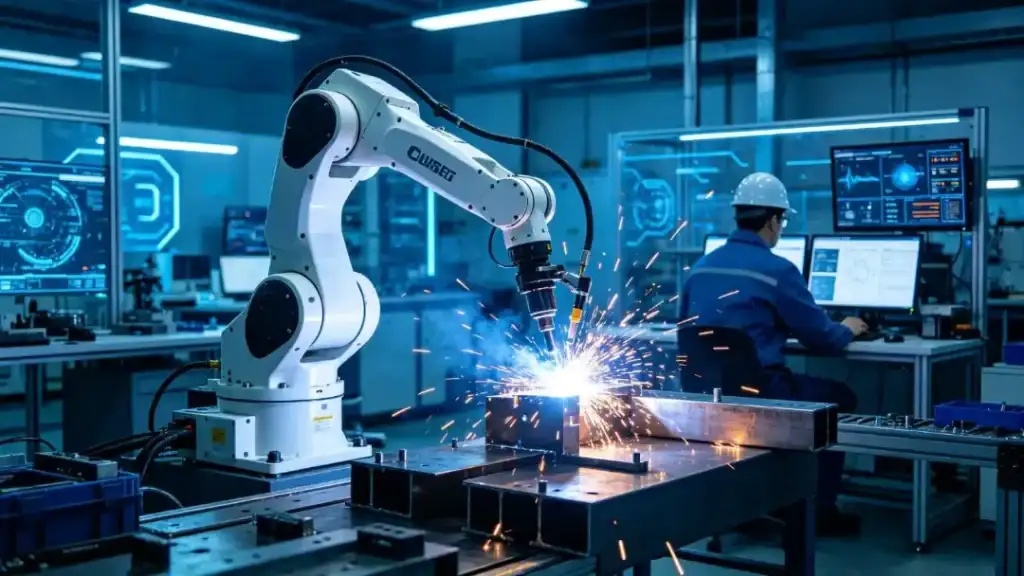
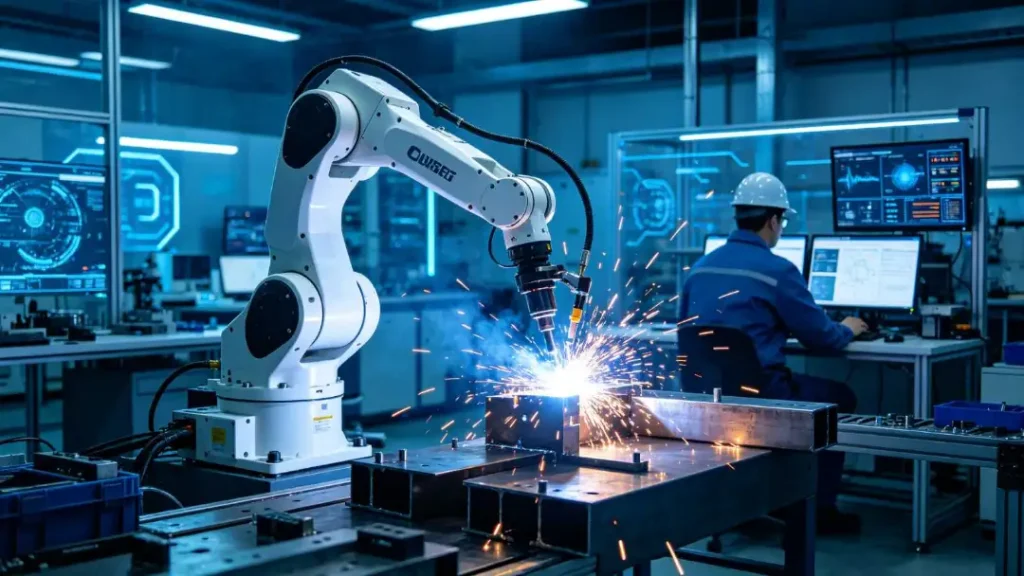
In 2026, China’s welding robot industry is at a critical transition point — shifting from “automation replacement” to “intelligent upgrading.” As the demographic dividend fades, manufacturing transformation accelerates, and AI technology rapidly penetrates industrial scenarios, the welding robot market is displaying a new set of trends and characteristics.
1. Market Size Continues to Expand, Penetration Rate Steadily Rising
In recent years, China’s welding robot market has maintained robust growth. Industry data shows that China has become the world’s largest industrial robot market, with welding robots accounting for approximately 20%–25% — making it one of the most widely applied industrial robot segments. As automation demand continues to grow across downstream industries such as automotive manufacturing, construction machinery, steel structure, and shipbuilding, the market penetration of welding robots is steadily increasing. Particularly among small and medium-sized enterprises (SMEs), falling equipment costs and improved usability are accelerating the adoption of welding robots beyond large corporations.
2. Vision and Sensing Technology Become Standard, Teach-In-Free Emerges as Mainstream
Traditional welding robots rely on manual teach-in programming, resulting in low changeover efficiency and high skill requirements for operators. In 2026, an increasing number of welding robot manufacturers are making vision recognition, laser seam tracking, and force sensing technologies standard features. By using vision sensors to automatically identify weld seam positions and dimensions, the system generates welding paths and process parameters automatically — achieving “teach-in-free, programming-free” intelligent operation. This trend significantly lowers the barrier to using welding robots and enables enterprises to quickly respond to flexible production demands of high-mix, low-volume orders.
3. AI Large Models Empower Welding Process into an Era of Intelligent Optimization
The rise of AI large model technology is profoundly transforming how welding robots optimize their processes. By learning and training on massive welding process datasets, large models can intelligently recommend optimal welding parameter combinations based on workpiece material, plate thickness, joint type, and welding position — and make real-time adjustments during welding. Meanwhile, based on multi-modal sensor fusion technology, the system can perform real-time welding quality monitoring and defect recognition, achieving closed-loop control of the welding process. The integration of AI technology evolves welding robots from “program-executing” automation devices into “perceptive, thinking, optimizable” intelligent equipment.
4. Flexible Manufacturing Demand Drives Rapid Growth of Mobile Welding Robots
In industries such as steel structure, shipbuilding, and large equipment manufacturing, workpieces are large, heavy, and difficult to move — making it hard for traditional fixed-position welding robots to cover all welding operations. In 2026, various forms of mobile welding equipment are developing rapidly, including rail-mounted mobile welding robots, AGV-chassis mobile welding robots, and climbing welding robots. These devices can move along the length of a workpiece to cover full-length welding of large components, and some products even feature autonomous navigation and automatic seam positioning. The emergence of mobile welding robots effectively solves the challenge of automated welding for large structures and expands the application boundaries of welding robots.
5. Human-Robot Collaboration Becomes a New Trend, Safe Interaction Technology Gains Attention
As welding robots are applied in more scenarios, the demand for humans and robots to work collaboratively in the same workspace is growing. Traditional welding robots are typically installed inside safety fences, isolated from human workers — which limits their application in flexible manufacturing scenarios. In 2026, collaborative welding robots with collision detection, torque limiting, and safe speed reduction features are beginning to emerge. These devices can work in close proximity to human workers while ensuring safety. Workers handle workpiece fixturing and complex-position welding, while robots handle repetitive long-seam welding — fully leveraging the strengths of each. The human-robot collaboration model is becoming a new direction in welding automation.
6. Green and Low-Carbon Concepts Deepen, Energy-Saving Welding Technology Gains Traction
Against the backdrop of China’s “dual carbon” goals, the green and low-carbon transformation of manufacturing is accelerating. As a high-energy-consumption process, welding’s energy saving and consumption reduction are receiving increasing attention from enterprises. In 2026, energy-efficient welding power sources, low-spatter welding processes, and precise heat input control technologies are developing rapidly. Meanwhile, through precise parameter control and stable welding processes, welding robots can effectively reduce welding defects and rework — lowering material and energy waste. The combination of welding robots and green welding technology is helping enterprises achieve cost reduction, efficiency gains, and low-carbon development simultaneously.
7. Industry Challenges and Opportunities Coexist
Despite the rapid development of the welding robot industry, several challenges remain. Core components such as high-precision reducers, servo motors, and controllers are still partially dependent on imports, and the level of independent control across the supply chain needs improvement. The complexity and diversity of welding processes mean that general-purpose welding robots still need refinement in certain specialized scenarios. Additionally, supporting systems such as maintenance services and talent training for welding robots need further development.
Overall, however, China’s welding robot industry is in an important period of strategic opportunity. As the intelligent transformation of manufacturing deepens, AI technology integrates more deeply with industrial scenarios, and the industry’s independent innovation capability continues to improve, welding robots will be applied in more industries and scenarios — driving Chinese manufacturing toward higher quality and higher efficiency.
For manufacturing enterprises, it is essential to closely monitor welding robot technology trends, assess their own production characteristics and needs, and systematically advance welding automation and intelligent upgrading — to gain an early advantage in an increasingly competitive market.