




Folks working in the welding industry, test your eye for quality with this picture.
There are six welds numbered 1 to 6 in the image. Which welded joint boasts the highest load-bearing capacity?
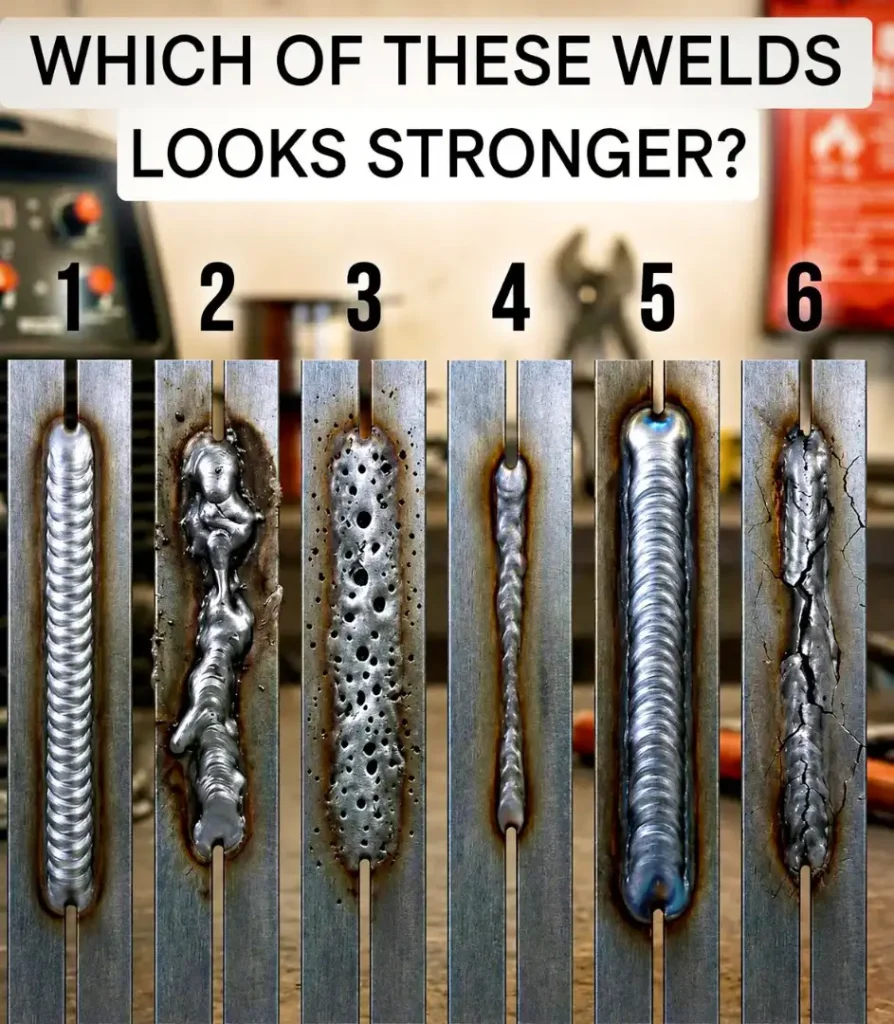
Let’s break down the flaws and features of each weld:
✅ Weld 1: Neat formation with uniform ripples, yet the weld bead is relatively narrow.
❌ Weld 2: Turbulent molten pool, uneven surface and unstable fusion.
❌ Weld 3: Covered in dense porosity with internal voids; prone to fracture under load.
❌ Weld 4: Narrow, thin weld bead with severely insufficient filler metal.
✅ Weld 5: Even ripples, adequate weld width, full bead profile, free of porosity and cracks with sound fusion.
❌ Weld 6: Visible extensive through-cracks; this weld must be rejected immediately.
👉 The correct answer: Weld No.5 delivers the maximum strength.
Many novice welders mistakenly pick Weld 1 due to its appealing ripple pattern, ignoring the insufficient bead thickness.
A nice-looking surface is only superficial. Freedom from porosity and cracks, complete fusion, and adequate filler volume are the core guarantees of weld strength.
Good appearance does not equal structural robustness. Only well-formed welds free of internal defects can withstand heavy loads.
Whether you rely on manual welding or teaching-free intelligent welding robots, consistent and stable control of the molten pool is always the foundation of high-quality welds.