




The manufacturing industry is rapidly moving toward intelligent automation, and welding processes are one of the key areas experiencing major transformation. Welding robot automation has become an effective solution for companies that need higher productivity, consistent welding quality, and reduced dependence on skilled labor.
For steel fabrication companies, construction manufacturers, and heavy equipment producers, robotic welding systems provide a reliable way to improve production efficiency while maintaining stable weld quality.
Unlike traditional manual welding, automated welding systems combine industrial robots, welding equipment, sensors, and intelligent control technology to complete complex welding tasks with higher precision and repeatability.
This guide explains what welding robot automation is, how robotic welding systems work, their benefits, applications, and how manufacturers can choose the right automation solution.
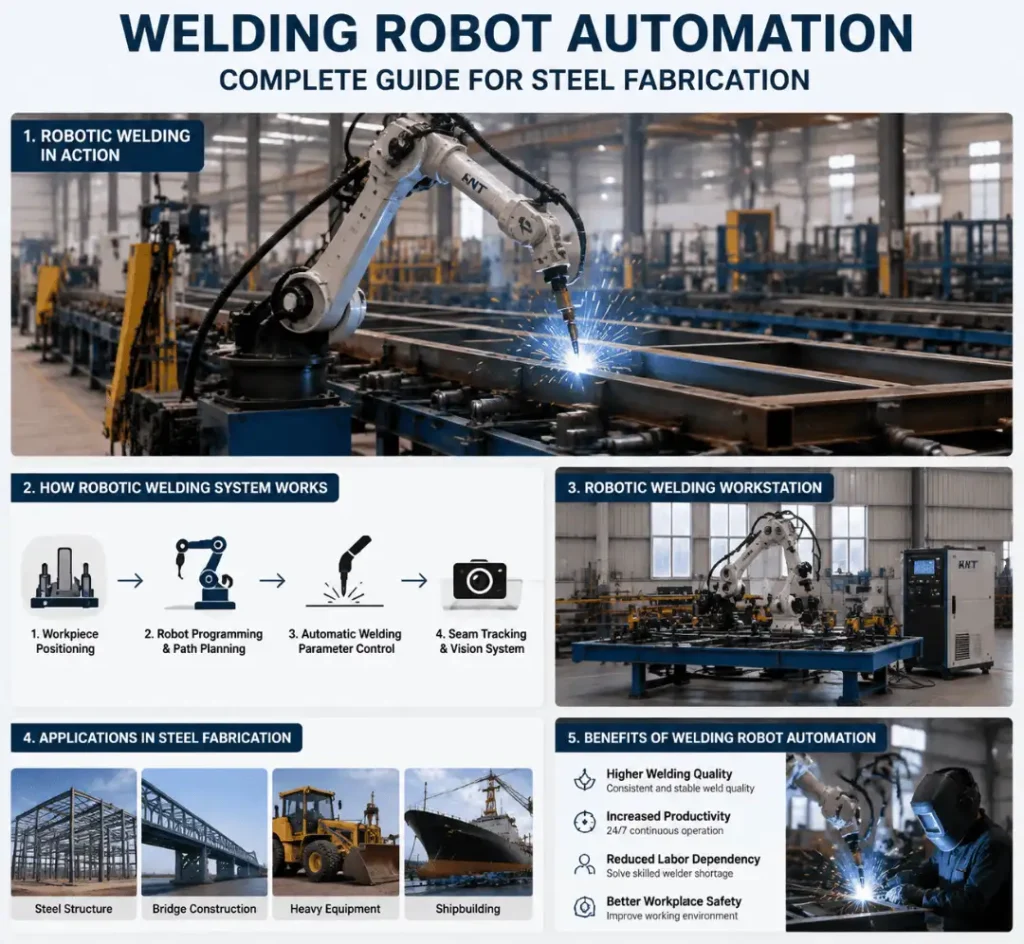
What Is Welding Robot Automation?
Welding robot automation is a manufacturing technology that uses programmable industrial robots to perform welding operations automatically.
A complete robotic welding system usually includes:
- Industrial welding robot
- Welding power source
- Robot controller
- Positioning equipment
- Welding fixtures
- Sensors or vision systems
- Intelligent software
The robot follows programmed welding paths and automatically controls welding parameters such as:
- Welding speed
- Current and voltage
- Torch angle
- Travel direction
- Welding position
Compared with manual welding, robotic automation provides a more stable and repeatable welding process, making it especially suitable for large-scale production.
How Does a Robotic Welding System Work?
1. Workpiece Positioning and Preparation
Before welding begins, the workpiece is accurately positioned using fixtures or welding positioners.
For large steel structures, proper positioning ensures:
- Accurate welding joints
- Reduced welding deformation
- Better production efficiency
2. Robot Programming and Path Planning
The welding robot follows programmed instructions to complete welding operations.
Modern robotic welding systems can use:
- Offline programming
- CAD model integration
- Automatic path generation
- Teaching systems
Advanced systems can reduce programming time and improve flexibility when producing different products.
3. Automatic Welding Parameter Control
A robotic welding system can precisely control welding parameters including:
- Welding current
- Voltage
- Speed
- Wire feeding rate
This helps maintain consistent weld appearance and strength.
4. Vision-Based Welding and Seam Tracking
Intelligent welding robots increasingly use cameras and sensors to identify welding positions.
Vision technology allows robots to:
- Detect weld seams
- Correct welding paths
- Adapt to part variations
- Improve welding accuracy
This is especially valuable for steel structures where components may have dimensional differences.
Why Choose Welding Robot Automation for Steel Fabrication?
1. Higher Welding Quality
One of the biggest advantages of robotic welding is consistency.
Manual welding quality depends heavily on operator experience, while robotic welding maintains stable parameters throughout production.
Benefits include:
- Uniform weld appearance
- Reduced welding defects
- Improved repeatability
2. Increased Production Efficiency
Welding robot automation allows manufacturers to increase output without increasing labor requirements.
Robots can:
- Operate continuously
- Maintain stable welding speed
- Reduce production downtime
For companies producing large steel structures, higher efficiency can significantly improve overall competitiveness.
3. Reduced Labor Dependency
Many industries face challenges caused by skilled welder shortages.
Robotic welding systems help manufacturers:
- Reduce dependence on manual labor
- Improve workplace safety
- Train operators more efficiently
4. Better Welding Safety
Welding environments often involve:
- Heat
- Smoke
- Sparks
- Heavy workloads
Automation allows workers to move away from dangerous welding areas and focus on system operation and management.
Applications of Welding Robot Automation
Steel Structure Manufacturing
Steel fabrication is one of the most common applications for welding robots.
Typical products include:
- Steel beams
- H-beams
- Structural frames
- Industrial buildings
Bridge Construction
Large bridge components require:
- Long welding seams
- High consistency
- Reliable quality
Robotic welding systems help improve production efficiency for bridge steel structures.
Heavy Equipment Manufacturing
Industries such as:
- Mining equipment
- Agricultural machinery
- Construction equipment
also benefit from automated welding solutions.
Types of Welding Robot Systems
Robotic Welding Workstation
A robotic welding workstation integrates:
- Robot arm
- Welding equipment
- Safety system
- Positioning system
It is suitable for manufacturers looking for a complete automated solution.
Cantilever Welding Robot System
Cantilever welding robots provide:
- Large working range
- Flexible operation
- Suitable for large structures
They are commonly used in steel fabrication plants.
Multi-Axis Welding Robot
Multi-axis robots offer:
- Higher flexibility
- Better welding accessibility
- Ability to handle complex weld positions
How to Choose a Welding Robot Manufacturer?
Before investing in automation, manufacturers should consider several factors.
1. Industry Experience
Choose a supplier with experience in your industry.
A steel structure welding project requires different solutions compared with small component welding.
2. Customization Capability
Every factory has different requirements.
A reliable welding robot manufacturer should provide:
- Factory layout planning
- Customized workstation design
- Integration services
3. Technical Support
Important services include:
- Installation
- Training
- Maintenance
- Remote support
Future Trends of Welding Robot Automation
The future of welding automation is moving toward intelligent manufacturing.
Key trends include:
AI Welding Technology
Artificial intelligence will improve:
- Automatic defect detection
- Welding parameter optimization
- Process control
3D Vision Systems
Vision technology will allow robots to understand complex workpieces without traditional programming.
Digital Manufacturing Integration
Future welding systems will connect with:
- CAD software
- Production management systems
- Smart factories
Frequently Asked Questions (FAQ)
What is welding robot automation?
Welding robot automation is a technology that uses industrial robots and intelligent systems to automatically perform welding operations with improved efficiency and consistency.
Are welding robots suitable for steel fabrication?
Yes. Welding robots are widely used for steel structures, heavy equipment, bridges, and large fabrication projects.
Can welding robots replace manual welders?
Robotic welding systems reduce repetitive manual welding work, but skilled workers are still needed for programming, operation, maintenance, and quality control.
How much does a welding robot system cost?
The cost depends on robot configuration, working range, automation level, welding requirements, and customization needs.
Заключение
Welding robot automation is becoming an essential technology for modern steel fabrication companies.
By combining industrial robots, intelligent control systems, and advanced welding technology, manufacturers can achieve:
- Higher productivity
- Stable welding quality
- Снижение зависимости от рабочей силы
- Improved manufacturing efficiency
KNT provides customized robotic welding systems, welding robot workstations, and intelligent automation solutions for steel fabrication and industrial manufacturing companies.
If you are planning to upgrade your welding production line, contact KNT for a customized welding automation solution.
CTA
Looking for a welding robot solution for your factory?
Our engineering team can help design a customized robotic welding system based on your product size, welding requirements, and production goals.
Request a free welding automation consultation today.