




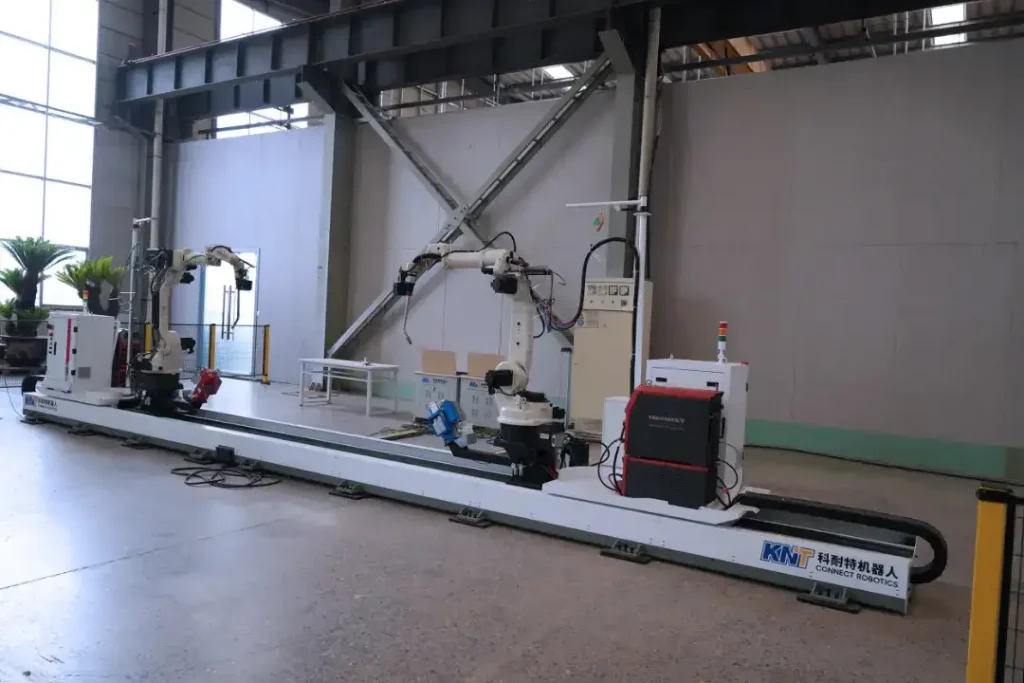
What Is Dual Station Welding?
Dual station welding is an advanced welding technology that integrates two independent welding stations into one welding system. Each station can be controlled separately with its own welding power source, gas supply, filler material, and welding parameters.
By allowing two workpieces or two welding tasks to be processed alternately or simultaneously, dual station welding systems significantly improve production efficiency, welding consistency, and overall manufacturing flexibility.
This technology is widely used in industries requiring high welding productivity, stable weld quality, and reduced labor costs, such as steel structure fabrication, heavy machinery manufacturing, and industrial equipment production.
What Are the Advantages of Dual Station Welding?
1. Higher Efficiency and Energy Saving
One of the biggest advantages of dual station welding is improved production efficiency.
With two welding stations operating alternately, operators can load and unload one station while the robot continues welding on the other station. This reduces machine downtime and maximizes equipment utilization.
Optimized welding parameters and intelligent control systems also help reduce energy consumption and improve overall production efficiency.
2. More Consistent and High-Quality Welds
Dual station welding systems provide stable welding conditions and precise parameter control.
Robotic welding technology minimizes human errors and reduces problems such as welding deformation, uneven weld beads, and residual stress.
As a result, manufacturers can achieve smoother, more uniform, and stronger weld seams with improved appearance and reliability.
3. Flexible Production for Different Workpieces
A dual station welding system can adapt to various workpiece sizes and welding requirements.
By adjusting welding programs, fixtures, and robot parameters, the system can handle different products without major equipment changes.
This flexibility makes dual station welding an ideal solution for customized production and multi-product manufacturing environments.
4. Lower Manufacturing Costs
By improving welding speed, reducing material waste, and decreasing manual labor requirements, dual station welding helps manufacturers reduce overall production costs.
The automated welding process improves resource utilization while maintaining consistent welding quality, providing better long-term economic benefits for factories.
5. Reduced Labor Intensity
Dual station welding usually works with robotic welding systems, eliminating the need for workers to perform repetitive welding operations for long periods.
Operators only need to monitor the system, manage workpiece loading and unloading, and perform basic production adjustments.
This greatly reduces physical labor intensity and creates a safer working environment.
Conclusion
Dual station welding provides significant advantages, including higher productivity, stable weld quality, flexible production capability, lower operating costs, and reduced labor requirements.
With the development of industrial automation, robotic dual station welding systems have become an important solution for modern manufacturing companies looking to improve welding efficiency and production competitiveness.
For steel structure manufacturers and industrial fabrication companies, investing in a dual station robotic welding system can help achieve faster production, better weld quality, and higher profitability.