In the competitive landscape of modern manufacturing, every second of production time matters. This reality has driven the widespread adoption of dual-station welding workstations—intelligent configurations that enable continuous welding operations with minimal downtime. By integrating two independent welding positions within a single robotic system, these advanced welding workstations are redefining what’s possible in high-volume production environments.
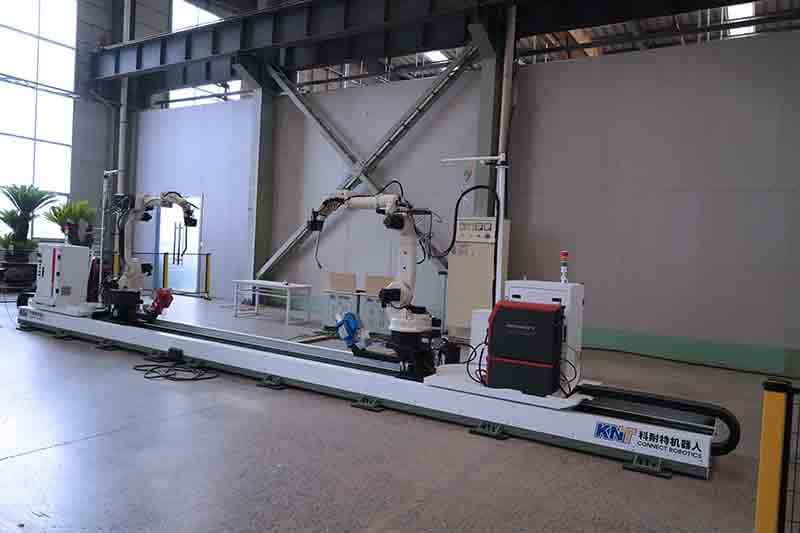
What Is a Dual-Station Welding Workstation?
A dual-station welding workstation is an advanced manufacturing cell that incorporates two separate welding positions served by one or more welding robots. Unlike traditional single-station setups where production halts during part loading and unloading, dual-station configurations allow welding to continue uninterrupted.
The principle is elegantly simple: while the welding robot works on a part at Station A, the operator simultaneously loads and unloads parts at Station B. When welding completes at Station A, the robot pivots immediately to Station B, and the cycle repeats. This seamless alternation eliminates the idle time that plagues conventional welding workstations, dramatically boosting overall equipment effectiveness.
Modern dual-station systems integrate sophisticated controls that manage power sources, gas supplies, filler materials, and welding parameters independently for each station. This independence ensures that each weld meets specifications regardless of what’s happening at the adjacent station, delivering consistent quality across every part.
The Compelling Advantages of Dual-Station Configurations
Manufacturers transitioning to dual-station welding workstations report transformative improvements across multiple dimensions of their operations:
1. Uninterrupted Production Flow
The most immediate benefit of dual-station welding workstations is continuous operation. Traditional welding setups force a choice: stop welding to load parts, or dedicate expensive robotic time to waiting. Dual-station configurations eliminate this compromise entirely.
In a typical implementation, the welding robot achieves near 100% arc-on time compared to 60-70% in single-station setups. For high-volume manufacturers, this 30-40% increase in productive welding time translates directly to increased output without additional equipment investment.
2. Superior Weld Quality Through Thermal Management
Dual-station operation offers unexpected quality advantages. By alternating between stations, the system naturally manages heat accumulation in fixtures and parts. This thermal cycling reduces distortion and minimizes residual stress, particularly important for thin-gauge materials and precision assemblies.
The result is more uniform, aesthetically pleasing welds with consistent mechanical properties across production runs. Manufacturers report significant reductions in post-weld straightening and rework when using dual-station welding workstations for heat-sensitive applications.
3. Exceptional Flexibility for Mixed Production
Modern dual-station welding workstations accommodate remarkable variety within a single cell. Each station can be configured with different fixtures, allowing the system to weld completely different parts without changeover delays.
This flexibility proves invaluable for manufacturers serving multiple customers or producing product families with frequent model changes. A single welding robot might weld heavy structural components at one station while precisely joining thin sheet metal at the other, switching between programs instantly as production demands dictate.
4. Dramatically Lower Production Costs
The economics of dual-station welding workstations are compelling. By maximizing robot utilization, these systems deliver more parts per equipment dollar than any alternative configuration. Labor costs per part drop as one operator manages loading for both stations, often with time to spare for other tasks.
Energy efficiency improves as well. The power supplies and ancillary equipment in dual-station welding workstations operate continuously rather than cycling on and off, reducing peak demand charges and improving overall energy utilization.
5. Reduced Physical Demands on Operators
For welding operators, dual-station welding workstations represent a significant quality-of-work-life improvement. The natural rhythm of loading one station while the robot welds at the other eliminates the frantic pace of single-station operations where operators rush to beat the robot’s cycle time.
This measured workflow reduces fatigue, lowers injury risk from repetitive motion, and allows operators to focus on quality rather than speed. In an era of skilled labor shortages, welding workstations that respect human limitations while maximizing productivity offer clear advantages for workforce retention.
Real-World Applications Across Industries
Dual-station welding workstations have proven their value across diverse manufacturing sectors:
Automotive Component Manufacturing
A Tier 1 automotive supplier recently deployed dual-station welding workstations for control arm production. Each station handles different part variants, with the robot switching between weld programs automatically. The system achieves 85% utilization while maintaining 50-micron positional accuracy across thousands of daily cycles.
Heavy Equipment Fabrication
A construction equipment manufacturer uses dual-station welding workstations to weld excavator components ranging from 10 to 500 kilograms. Heavy-duty turntables at each station position parts optimally for the robot, while integrated safety curtains allow operator access to one station while the robot works at the other.
Structural Steel Processing
A steel service center processes beams and columns through dual-station welding workstations equipped with extended-reach robots. One station handles long structural members while the other processes smaller connections and fittings, maximizing floor space utilization while maintaining continuous production.
Key Considerations for Implementation
Success with dual-station welding workstations requires thoughtful planning:
Fixture Design Matters
Quick-change fixturing becomes essential when processing different parts at each station. Magnetic, pneumatic, or manual clamping systems that allow rapid part changes maximize the productivity potential of dual-station configurations.
Safety Integration Requires Care
Dual-station welding workstations must balance operator access with arc flash protection. Light curtains, area scanners, and interlocked barriers that allow safe access to one station while the robot operates at the other are critical for both safety and productivity.
Robot Reach Defines Capability
The robot’s working envelope must comfortably cover both stations with full articulation. For larger parts, track-mounted robots that move between stations may offer advantages over fixed-base configurations.
Control System Sophistication
Modern dual-station welding workstations require controls capable of managing independent weld schedules, safety zones, and operator interfaces for each station. Look for systems with intuitive programming that simplifies switching between different parts and processes.
Future Trends in Dual-Station Welding
The evolution of dual-station welding workstations continues apace. Emerging developments include:
- AI-powered scheduling that optimizes which parts run at which station based on weld complexity and production priorities
- Collaborative robot integration allowing operators to work alongside robots in the active station for complex assembly tasks
- Automated guided vehicles that deliver parts directly to each station, eliminating operator loading entirely
- Advanced vision systems that verify part placement and adjust weld paths automatically, reducing fixture requirements
Conclusion: Strategic Value Beyond Productivity
For manufacturers evaluating their next equipment investment, dual-station welding workstations offer compelling advantages that extend beyond simple productivity metrics. These systems deliver higher quality through better thermal management, greater flexibility through independent station operation, and improved operator working conditions through balanced workflow.
The initial investment in dual-station welding workstations typically returns to the bottom line within 12-18 months through increased output and reduced costs. For companies committed to manufacturing excellence in competitive global markets, dual-station configurations represent not just an equipment choice, but a strategic advantage.
As manufacturing continues its evolution toward smart, flexible production, welding workstations that maximize robot utilization while accommodating product variety will only grow in importance. Dual-station technology, proven across decades of industrial application, stands ready to meet these demands while delivering the quality, efficiency, and flexibility that modern manufacturing requires.